
I grew up in Gawler, South Australia, and found myself architecturally bothered. There was a stark contrast between the town’s quaint 19th century heritage, and the new cul de sac filled sprawl which marked it as but a northern suburb of the “greater” City of Adelaide.
After school, I took a gap year working in the North Yorkshire countryside, regularly visiting Gothic cathedrals and Roman ruins, and admiring English country houses. I returned to Australia eager to commence tertiary education in architecture. However, I was interested in beautiful architecture, and so, wary of the ideologies of architecture schools, I decided to steer clear of design and instead aim to specialise in the structural preservation of buildings of great beauty, age, and heritage significance, like cathedrals, palaces, and temples. I commenced a Bachelor of Structural and Architectural Engineering at the University of Adelaide in 2016, and graduated with First Class Honours in 2020.
In the last few years of my engineering degree however, I had come across a new school of architectural thought which turned me back towards design. What I had understood to be a ‘mandatory’ adherence to stripped back forms and industrial materials, a fundamental and irrevocable change in the architecture profession from old world building, was simply a fad created in the mire of early 20th century creative degeneracy.
Architects today are making an active choice to avoid the use of natural building materials, traditional building methods, intricate ornamentation, and time-tested geometries and symmetries. A different choice can be made. So, I contacted architects in the UK who were writing about traditional and classical building design, and on their recommendations, I applied to study a Master of Architecture at the University of Notre Dame in the United States- the only school in the world to teach architecture in the classical tradition. Following my acceptance into the program, I was awarded an inaugural World Universities Postgraduate Scholarship from the Ramsay Centre for Western Civilisation to support my studies in the US and commenced the program in August 2021.


It was exceedingly refreshing, after taking undergraduate architecture courses (in which illogical abstraction was highly praised), to suddenly have professors grounded in common sense… “Of course it needs a pitched roof so water can run off efficiently!”, “Of course the entrance should be in the centre, it’s an entrance, people need to find it!”, “Of course you should have less window than wall in a façade, how else are you supposed to efficiently cool and heat the building?” Rather than “the undulating organic shapes created by the steel and glass in my design are inspired by the flight paths of endangered local bird life” sort of thing. Not to mention, all projects at Notre Dame were to be designed and drawn by hand, and all hand painted in watercolour. It is a real joy to spend hours in front of a piece of paper with pencil in hand working and reworking drawings. A very different experience to hours in front of a blue screen of Revit or AutoCAD.
In my first year we studied the fundamental principles of classical architecture under Professor Richard Economakis, who assigned us a project in Chicago for our first semester- easily accessible for site visits, being only two hours away. In the second semester we were assigned a project in Athens, and we studied techniques of apartment planning and larger scale urban planning under both Professor Economakis and the amazing German architect Sebastian Treese who came in as a guest lecturer. We all travelled to Greece in the Spring Break to undertake site research and present our initial concepts to the Mayor of Athens.
Through Notre Dame, I had been chosen to participate in an archaeological dig on the Greek island of Samothrace that summer. I worked with researchers from Princeton and Emory Universities, analysing and documenting the ancient architecture there and then undertook an archaeological tour of the Peloponnese funded by Notre Dame’s Nanovic Institute. I had taken the next academic year off and so returned to Australia after the Summer and worked for a few months in Sydney gaining valuable design experience as a Junior Architectural Designer at M.J. Suttie Architects, an exclusively classical architecture firm at Potts Point.
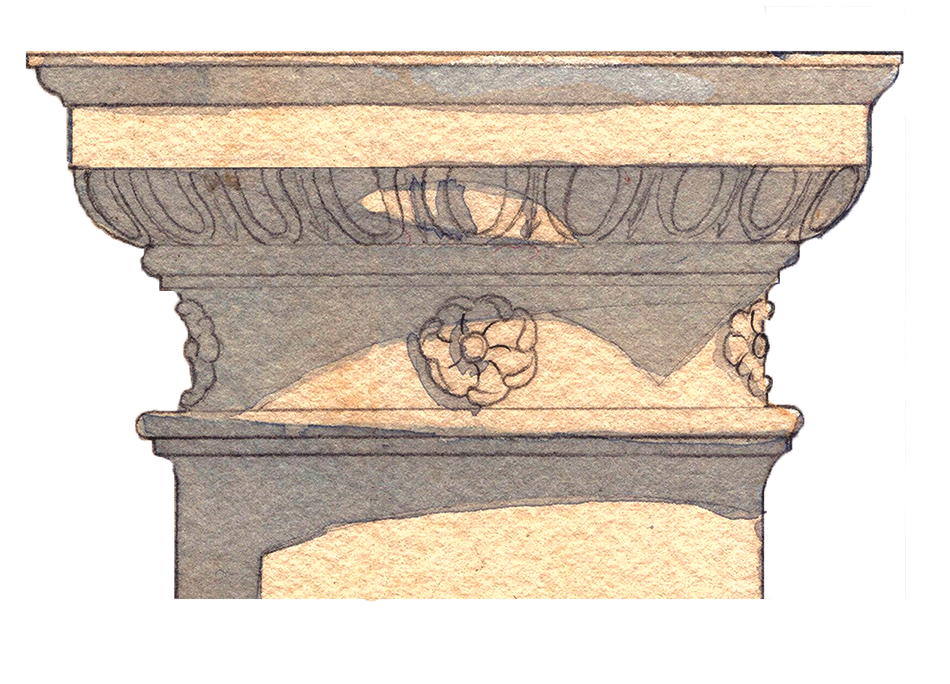
I returned to Notre Dame in August of 2023. My second year started with a studio in gothic architecture, where my class designed a college campus in the collegiate gothic style of Cambridge and Oxford. My second semester studio was led by the great American church architect Duncan Stroik, who gave us an immersive course in the architectural approach of Palladio. In our first week we were asked to construct a Doric column in the style of Palladio, drawn in charcoal at 1:1 scale (only 1ft wide at its base). The second week we were to design an Ionic atrium, and the third a full façade for a museum, and so on. This studio finished with the design of a symphony hall in Chicago.
In my summer holidays, before commencing my third year at Notre Dame, I got married. My husband then joined me in Rome for our semester there. Living in Rome was breathtaking. Our apartment was opposite the convent at Quattro Coronati, just four blocks from the Colosseum. The immersion into architectural history I received in Rome was incredibly formative. Under the guidance of the German architect Thomas Albrecht, and the Italian architect Ettore Mazzola, we undertook an urban design studio focusing on the redesign of the rundown Ostiense neighbourhood. I designed a chapel and convent as a part of the project.
Returning to the US, I commenced my final semester- mainly consisting of a comprehensive thesis project of my own choice. For my thesis I designed a grand State Opera House for the city of Adelaide. The site of this opera house was to be the current Adelaide Festival Theatre site. I “bulldozed” everything beyond North Terrace from King William Street to Morphett Street, except the beautiful buildings of course- the Adelaide Train Station, Parliament House, and the quaint boathouses by the river- slightly controversial I know. I came up with a new urban plan for the site- actually respecting the official Parklands designation of the area, and placed the new opera house within, surrounded by picturesque, terraced gardens leading down to the river. I look forward to exhibiting this project in Adelaide in the near future.
After graduating in May 2025, I returned to Adelaide with my husband, already 6 months pregnant. While my priorities have now shifted, I am excited to continue this pursuit for architectural beauty as time allows. I hope to share my learning with anyone who is interested, and do my best to advocate for a return to beauty and common sense in architecture.